Basics of NLP - 1 [Week 5]
discussion into how text preprocessing, regex, frequencies, and word embeddings work
You must have used ChatGPT, but how does it work? How does Google Translate work? They all work under the study of Natural Language Processing. Today, we embark on a long journey which was inspired from a tweet from Saurabh Bhaiya [Link to Tweet - Saurabh Kumar on Twitter / X]. Let’s dive deep into the study of NLP.
This blog is broken into 4 pieces
- Text Preprocessing - Lowercasing, Tokenization, Stopword Removal, Stemming, Lemmatization
- Regex - Basics and some examples
- Frequencies - BoW, TF, IDF, TF-IDF
- Word Embeddings - Word2Vec, GloVe
Text Preprocessing
We will be using the NLTK library for this task, make sure import it earlier on using import nltk
Lowercasing
This step is obvious, we do this to ensure consistency. It also reduces the complexity of the text data we are going to input. We can simply just convert every character in the test data to its lower case form.
text=#your input data
text=text.lower()
Tokenization
Imagine you want to teach your kid to study English, instead of teaching him Shakespeare, you will first teach him alphabets, then words then sentences.
Here your child is the machine, and we break down sentences for it to learn so that the sentence is broken into meaningful tokens, which still carry the original essence of context. This makes pattern recognition easier.
Let’s say we have a sentence I am neuralnets.
We can break it down to ["I","am","neuralnets"] . This is word tokenization, which breaks long sentences into individual words.
Now let’s go down one step further. ['I', ' ', 'a', 'm', ' ','n', 'e', 'u', 'r', 'a', 'l', 'n', 'e', 't', 's'] . This kind of tokenization is called character tokenization, mostly used for spelling correction tasks.
We can also break words neuralnets to ["neural","nets"].This kind of tokenization is termed as subword tokenization. This is useful for languages that form meaning by combining smaller tokens.
import nltk
from nltk.tokenize import word_tokenize
nltk.download('punkt')
tokens = word_tokenize("I am neuralnets.")
print("Tokens:", tokens)
Stopword Removal
What is a stopword? They are usually the words that don’t contribute any meaning or context to the sentence. For example, the word the doesn’t bring out any significance to the sentence, hence we can just remove it from the input data. But words which have important context to the sentence, like for example, history can’t be termed as stopwords.
from nltk.corpus import stopwords
stop_words=set(stopwords.words('english')
#this forms a set of stop words
words=[word for word in tokens if word not in stop_words]
#this stores all words in tokens, that are not stopwords
Stemming
Let us consider this sentence, The leaves are falling, have fallen, but will leave behind beauty
With stemming, what we do is chop down the sentence into their root forms, which might not make any sense and lose the meaning of the word.
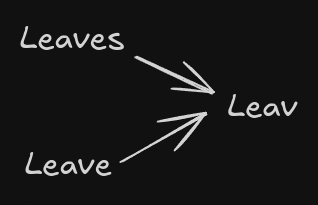
from nltk.stem import PorterStemmer
from nltk.tokenize import word_tokeniz
text = "The leaves are falling, have fallen, but will leave behind beauty."
words = word_tokenize(text)
stemmer = PorterStemmer()
stems = [stemmer.stem(word) for word in words]
print("Stemming Results:", stems)
Lemmatization
Consider the earlier sentence.
What we do here, is we chop down the sentence into their base dictionary word, which considers the meaning and context of the word, hence not making a word, that makes no sense.
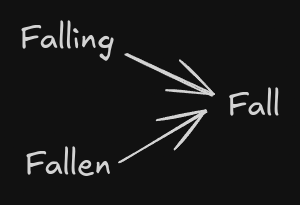
from nltk.stem import WordNetLemmatizer
from nltk.tokenize import word_tokenize
text = "The leaves are falling, have fallen, but will leave behind beauty."
words = word_tokenize(text)
stemmer = WordNetLemmatizer()
lemmas = [lemmatizer.lemmatize(word, pos="v") for word in words]
print("Lemmatization Results:", lemmas)
Regular Expressions(Regex)
A regular expression (shortened as regex) is a sequence of characters that specifies a search pattern in text. Basically it’s a way of finding and searching stuff in a string.
How to write Regex?
→ First we import the regex module with import re
→ Then we need to create a regex object with re.compile
→ We need to pass our input string into the Regex object using search() , which returns an object
→ Finally call the group() function to return a string output from the object.
Common Regex Symbols
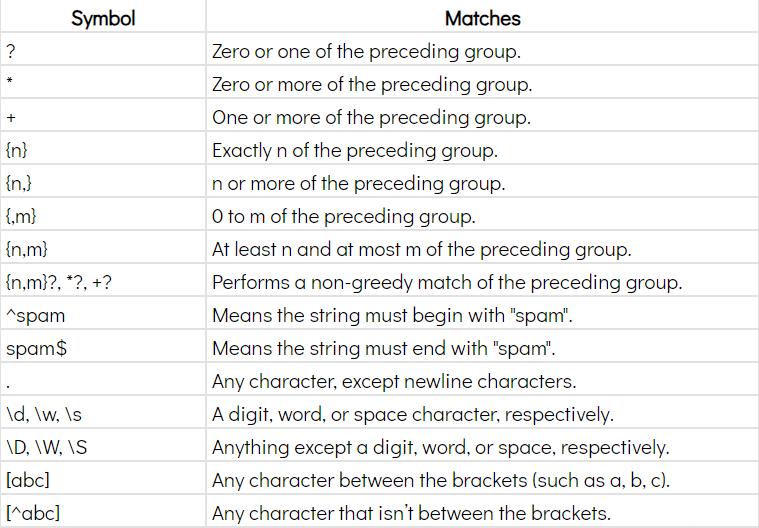
Example
phone_num_regex = re.compile(r'\d\d\d\d-\d\d\d\d\d\d')

mo = phone_num_regex.search('My number is 9834-872919.')

print(f'Phone number found: {mo.group()}')
#this will output the number in the string
Since this topic is very practical, and should be learnt through practice, you’re suggested to try examples out on your own to get the grasp of regex!
Check out - https://docs.python.org/3/howto/regex.html
Frequencies
Bag of Words(BoW)
It is nothing but a simple way to represent text data. We don’t care about the order of words not the grammar, we just care about what words appear in the sentence. It’s like putting words in a bag and then randomly counting each type of word.
Firstly, we need to create a vocabulary, that is all the unique words in our dataset. Then we count how often each word occurs in the vocabulary.
Let’s say we have sentences
S1 : I like pizza
S2 : I do not like pizza
Our vocabulary will be ["I", "like", "pizza", "do", "not"]
Now we count the number of appearances
| Word | Sentence 1 | Sentence 2 |
|---|---|---|
| I | 1 | 1 |
| Like | 1 | 1 |
| pizza | 1 | 1 |
| do | 0 | 1 |
| not | 0 | 1 |
| Total Words | 3 | 5 |
The BoW representation is :
1. Sentence 1 : [1,1,1,0,0]
2. Sentence 2 : [1,1,1,1,1]
The BoW model represents each sentence as a vector, where each dimension is a word in the vocabulary and the value in it represents the count of that word.
Term Frequency(TF)
It measures how often a specific word appears in a document, compared to the total number of words in that document. Instead of counting like in BoW, TF normalises the counts, thus for larger datasets, we can see how important a word is in context of the document. It sets the stage for more advanced models to come.
The formula for TF is
We will be using the same example like the last time.
| Word | TF of Sentence 1 | TF of Sentence 2 |
|---|---|---|
| I | 1/3 = 0.333 | 1/5 = 0.2 |
| Like | 1/3 = 0.333 | 1/5 = 0.2 |
| pizza | 1/3 = 0.333 | 1/5 = 0.2 |
| do | 0 | 1/5 = 0.2 |
| not | 0 | 1/5 = 0.2 |
| Total Words | 3 | 5 |
Inverse Document Frequency(IDF)
While TF told us about the importance of a word in a document, IDF tells us about how rare or unique a word is in the document. Using this, we can often eliminate words that carry very less context, rather than the rare words which might carry huge context. Words that appear in every document get a lower IDF (close to 0). Words that appear in fewer documents get a higher IDF.
The formula is :
We will be using the same example like the last time.
| Word | Document Frequency |
|---|---|
| I | 2 |
| like | 2 |
| pizza | 2 |
| do | 1 |
| not | 1 |
Now let’s calculate the IDFs :
| Word | Document Frequency | IDF |
|---|---|---|
| I | 2 | 0 |
| like | 2 | 0 |
| pizza | 2 | 0 |
| do | 1 | 0.693 |
| not | 1 | 0.693 |
IDF helps downweight common words (like "I") and emphasize rare words (like "do" and "not"), which are often more meaningful for distinguishing between documents.
TF-IDF
TF tells us how important a word is in a document, IDF tells us how rare that word is. Combining them gives a score that tells us how important a word is in a document, while leaving behind common words.
The formula is :
We will be using the same example like the last time.
| Word | TF-IDF in S1 | TF-IDF in S2 |
|---|---|---|
| I | 0.33 x 0 = 0 | 0.2 x 0 = 0 |
| like | 0.33 x 0 = 0 | 0.2 x 0 = 0 |
| pizza | 0.33 x 0 = 0 | 0.2 x 0 = 0 |
| do | 0 x 0.69 = 0 | 0.2 x 0.69 = 0.13 |
| not | 0 x 0.69 = 0 | 0.2 x 0.69 = 0.13 |
TF-IDF highlights that words like "do" and "not" are more important to Sentence 2 because they are rare in the dataset.
Word Embeddings
Introduction
Word embeddings involves representing words as numerical vectors in a continuous vector space. Here, each word is mapped to a vector of real numbers in a high-dimensional space.
They help us to understand how words are related to each other, and hence we can solve questions like
They capture the contextual meaning behind all the words, hence understanding a language in depth.
Word2Vec
Original Paper - arxiv.org
What word2vec works in such a way, that it causes words that tend to occur in same type of contexts, to have embedding values similar to each other.
Let’s consider two sentences.
S1 : The child threw the ball across the park.
S2 : The kid threw the ball across the park.
Here, due to word2vec, the words child and kid will have similar embedding vectors, as they have similar context in these sentences.
How does it work?
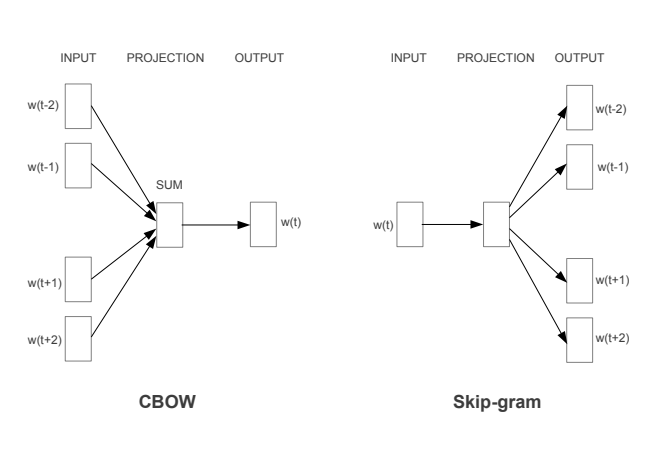
This is how the Word2Vec model looks like, confusing at first right?
Let’s decode its parts one by one.
CBOW(Continuous Bag of Words)
Let’s define a vocabulary first
Vocab : What is life if not a rise to the top
We create a One Hot Vector for each of the words.
What is One Hot Vector? (extra)
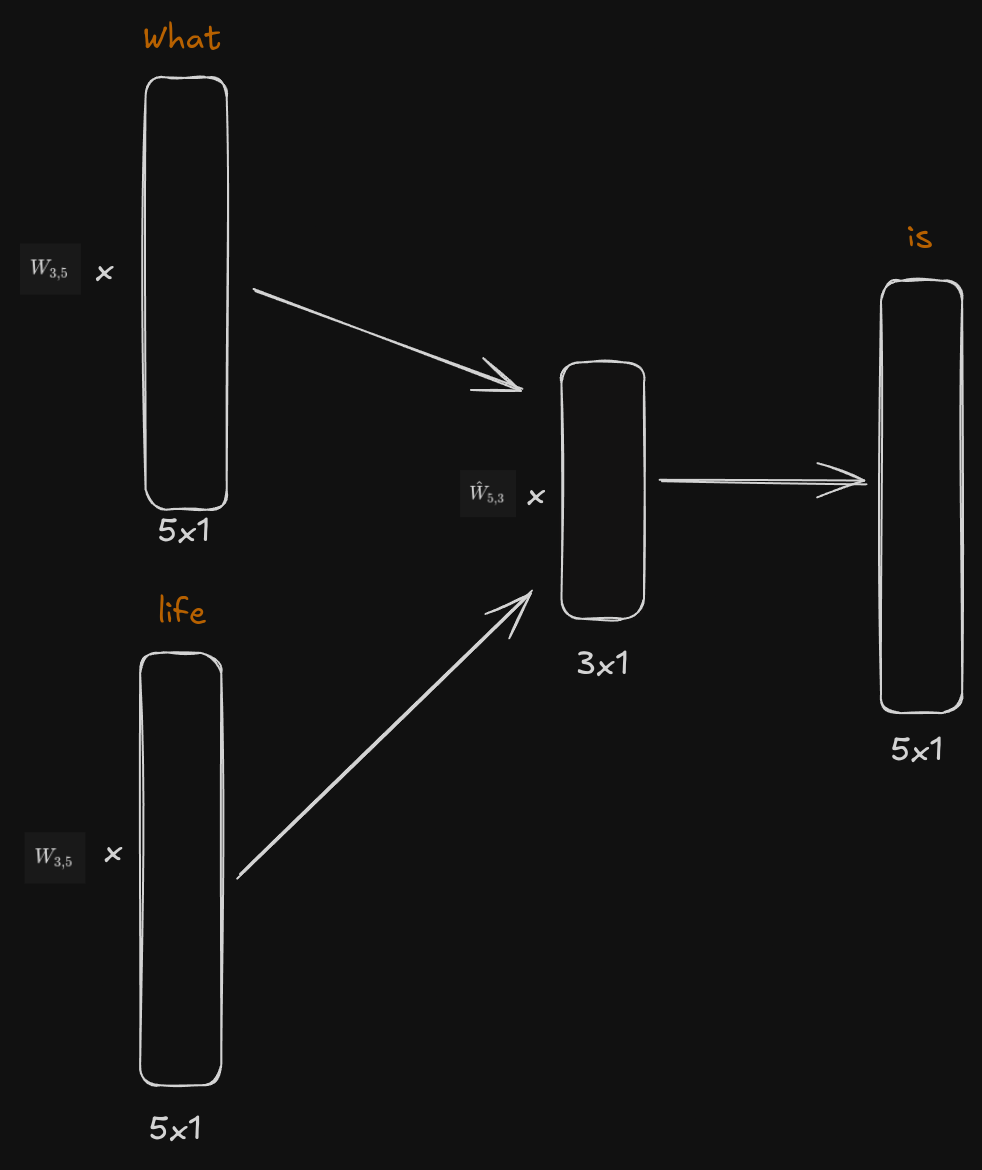
We need to define a context window now, let it be 3 words.
What we aim to do in CBOW is, we will input the left and right words, which will try to predict the middle most word. In our case, let’s see What is life.
We devise a neural network structure which inputs the two one-hot vectors and converts them to a \(3\) x \(1\) hidden layer, which gets converted into a 5x1 matrix to give the output of the is ,after we run it through the activation layer of Softmax.
Weights are updated throughout all the context windows, is life if, then life if not and so on, and this how we work with CBOW!
Skipgram
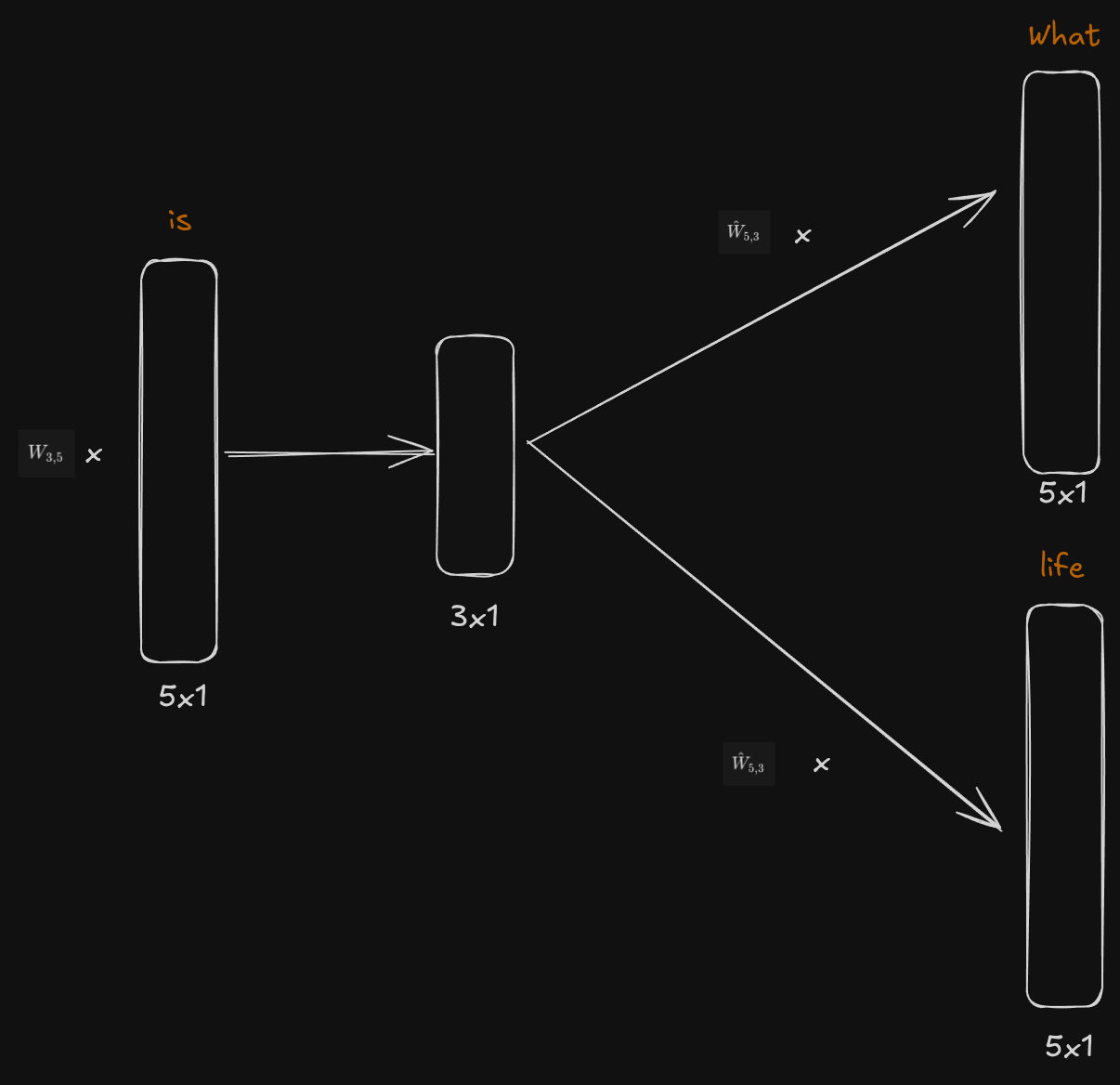
Skipgram works exactly in the reverse manner of how CBOW works.
Here we take the centre word and then try to predict the other words surrounding it using a neural network.
(I will skip discussion as the process is similar)
Why use it?
- It preserves the relationship between word.
- It also deals with new words, by assigning them new vectors.
GloVe
Original Paper - nlp.stanford.edu
It is an unsupervised learning algorithm that is designed to learn word embeddings, by making statistical relations between words in a large corpus. It tries to find the co-occurrence patterns in a corpus
Let us consider a set of sentences
- I enjoy flying.
- I like NLP.
- I like deep learning.
From these sentences, let’s list the unique words:[I, enjoy, flying, like, NLP, deep, learning]
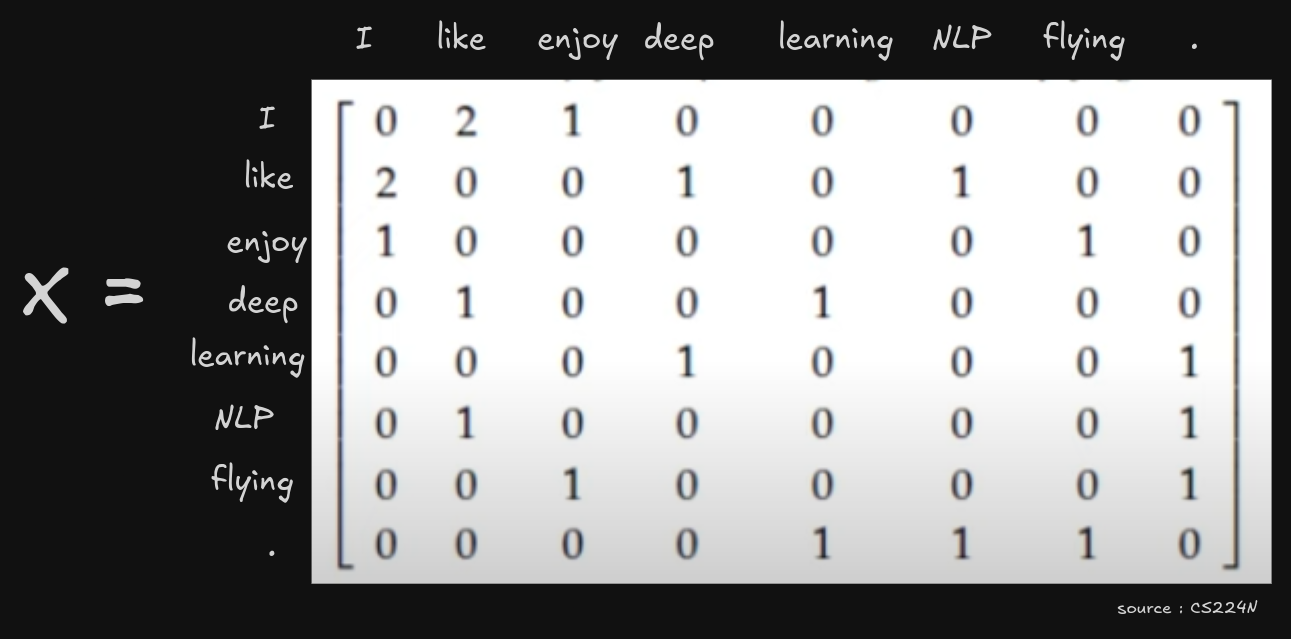
We need to fix a context window, here too like Word2Vec. Let’s make it 1. That means we will only check co-occurrence with the adjacent word, aka the word earlier and the word later
Now we want to make a co-occurrence matrix \(X\)
Now let’s understand by taking an example.
See the word deep , deep has the words like before it and learning after it.
So logically deep should have only like and learning values set to 1. If you check that is the case horizontally as well as vertically
This co-occurrence matrix comes out to be symmetric, if you notice. Can you think why is it the case? (Thought exercise for the reader)
Any element in this matrix is denoted by \(x_{ij}\) where it means how many times is i succeeded by j in the corpus.
\(x_i\) will denote each row, which is basically how many times i with being succeeded by each word in the corpus.
Hence, the probability comes out to be,